


Some of the productions that caught our attention lately have very little in common at first glance. One happened above New York Harbor, another involved a giant manta ray in the middle of the desert, one took over a 51,000-seat arena, while another transformed around a single performer on stage.
But look a little closer and there’s a common thread: in each case, the space itself became part of what people came to experience. Here are four productions we think are worth a closer look.
Together, they show how event scenography can turn a venue from a backdrop into an active part of the experience.
1. New York turned 2,977 individual lights into one powerful installation
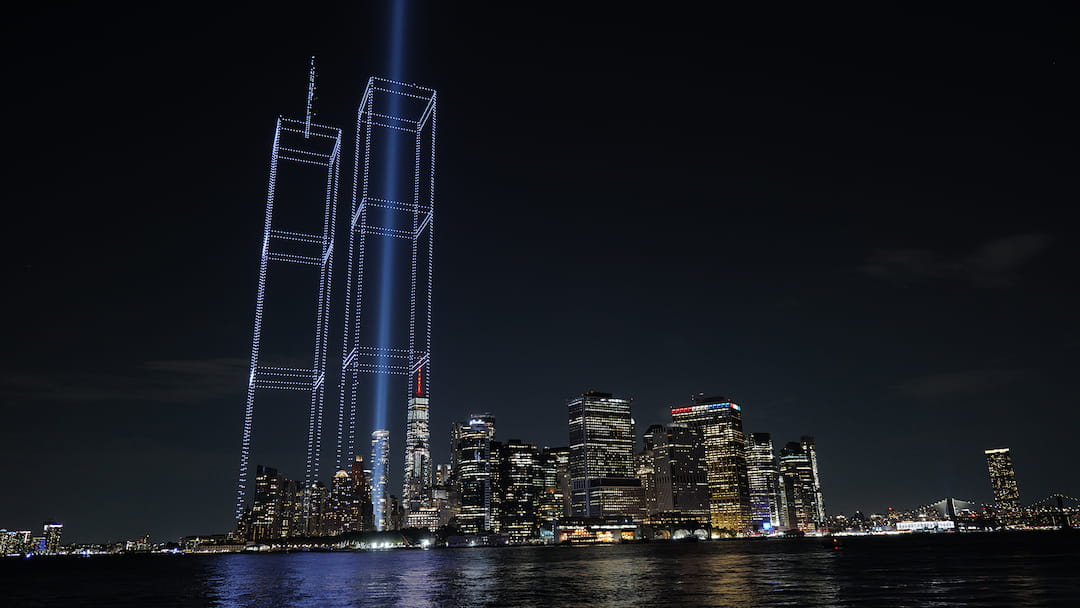
Photo Credit: Craig Barritt / Getty Images
Ahead of the 25th anniversary of 9/11, 2,977 lights rose above New York Harbor, one for each person who lost their life in the attacks.
The lights first moved together in a helix before gradually forming the outline of the Twin Towers at full architectural scale. The artwork was visible from multiple locations around the harbor, so there was no stage, no designated audience and no single “best seat” from which to experience it.
The project, titled 2,977 Lights Over New York Harbor, was developed over two years with the involvement of 9/11 families, survivors and first responders.
Why we think it matters
There is a tendency to make new technology the headline whenever it appears in an event or activation. This project did almost the opposite.
The technology was essential, but it wasn’t what people were asked to look at. It stayed in the background and served a very simple visual idea, which made the final result all the more powerful.
2. At Burning Man, a swing controlled something much bigger
There are plenty of interactive installations that ask you to learn how to interact with them. Hahalua starts with something almost everyone already knows how to use: a swing.
Created by Christopher Schardt for Burning Man, Hahalua is a 24-foot manta ray suspended around 18 feet above the ground, with 25,000 LEDs covering its underside. Beneath it sits a wide porch swing.
As people swing back and forth, the movement is translated into the movement of the manta ray’s enormous wings overhead. Meanwhile, its LEDs display animations synchronized with a soundtrack ranging from classical music to classic rock.
But the part we like most happens around the swing. Only a handful of people can interact with Hahalua at one time, yet everyone nearby can see the wings move and watch the light show unfold.
Why we think it matters
Interactive doesn’t necessarily have to mean everyone interacting at the same time. Here, a few people trigger the experience, but a much larger audience gets to enjoy the result.
That’s a useful idea when you’re designing interaction for events where hundreds or thousands of people share the same space and all of it starts with something as familiar as a swing.
3. The World Nomad Games blurred the line between screen and arena
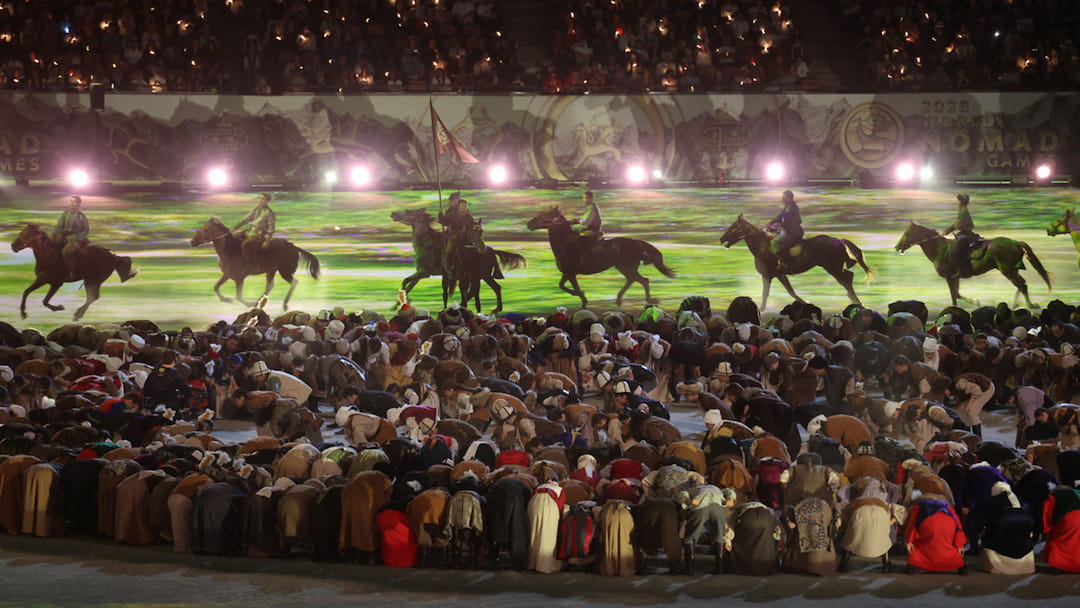
Photo credit: News from A to Z.
Opening ceremonies are no strangers to huge screens, projections and large-scale visuals. At the World Nomad Games 2026 in Bishkek, however, the digital content felt much more integrated into the performance itself.
Throughout the ceremony, mountains, snow, fire, animals and landscapes were used to transform the arena and support the live choreography, rather than simply sit in the background.
Combined with performers, horses, lighting and large-scale movement, the visuals helped turn the entire space into part of the show.
Why we think it matters
Large screens can easily become very expensive backdrops. What worked here was the relationship between the content and everything happening in the physical space. The screens introduced environments and actions that performers could then pick up and continue live.
Instead of asking “what should we put on the screen?”, the more interesting question became “what can the screen allow us to do in the room?”
4. Céline Dion’s stage didn’t stay the same for very long
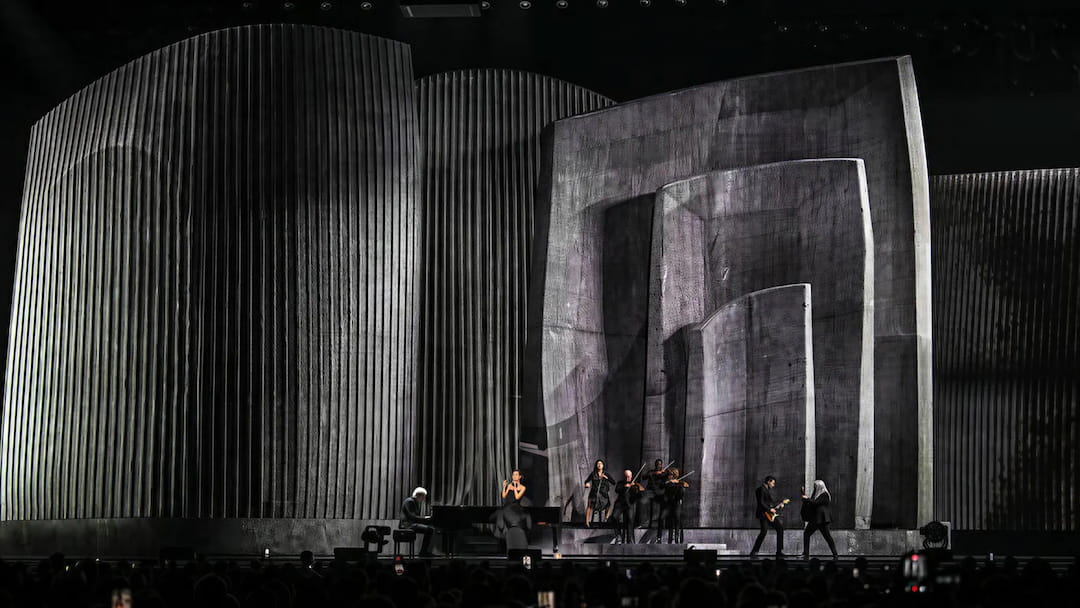
Photo credit: Celebs100
For Céline Dion’s Paris shows, Willo Perron and Perron Studios built the scenography around three enormous mobile monoliths.
At first glance, that’s a relatively restrained setup. But the structures continually open, close and move into different configurations, changing the architecture around Céline as the show progresses.
At different moments, the stage reveals a huge jagged rock formation and a rotating quartz crystal chandelier that eventually transforms into a disco ball. Later, much of the scenography disappears altogether and the exposed technical rigging becomes part of the visual language of the show.
Here, the interesting part is how much mileage the production gets out of a relatively small number of major scenic elements.
Why we think it matters
A stage doesn’t need a completely new setup for every moment to feel different. Movement, scale, lighting and changes in configuration can keep transforming the same physical elements throughout a show.
Instead of designing a collection of individual hero moments, the set itself becomes something that evolves with the performance.
What event scenography can teach corporate events
Technology, scenography, and content should work as one system. Technology doesn’t have to be the spectacle, it can enable the spectacle.
What makes these large-scale productions relevant to corporate events isn’t their scale, but the thinking behind them. You don’t need a stadium, thousands of lights or a massive kinetic installation to borrow the same principles: a space that transforms throughout the agenda, technology that changes how people interact, or scenography that becomes part of the story rather than simply framing it.
The production may scale down, but the idea doesn’t have to. The interesting challenge is translating big-show thinking into experiences that make sense for 100, 300 or 1,000 people and for a completely different kind of audience.
Planning something bold? Bring us the brief.
From team building activities and corporate events to brand activations and large-scale productions, we’re always up for a good challenge.
Let’s chat about your next event!
Article structure
Similar articles
 August 19th, 2026
Every year, the same line item forces the same decision: put the whole event
 July 29th, 2026
Ever wonder why the world's biggest events just... work? If you're the person who
 July 21st, 2026
Every week, the event industry raises the bar a little higher. Not always through
 June 10th, 2026
It's All About the Objective. We'll be honest with you: we didn't figure this


